
1. Introduction: The Dialectic of Two Worlds
The history of heavy music in the late 20th and early 21st centuries is dominated by the collision of two distinct but related subcultures: heavy metal and ***** punk. Metalcore, the progeny of this union, stands as arguably the most commercially successful and culturally significant sub-genre of extreme music to emerge since the thrash metal explosion of the 1980s. Metalcore overview (Wikipedia) It is a genre defined by contradiction and synthesis—melding the technical precision, high production values, and melodic aspirations of metal with the ethical urgency, rhythmic primitivism, and community-centric ethos of *****. Metalcore overview (Wikipedia)
While often dismissed by purists of both parent genres as a bastardization, metalcore has demonstrated remarkable resilience and malleability. From its embryonic stages in the gritty, violent club scenes of the late 1980s to its dominance of the Billboard charts in the mid-2000s and its current fragmentation into digital and progressive micro-genres, metalcore has served as the primary gateway for younger generations into heavy culture. Who invented metalcore? (Loudwire)
This report offers an exhaustive analysis of the genre’s evolution, tracing its sonic lineage from the crossover thrash of the Reagan era to the polished, synthesizer-laden soundscapes of the 2020s. It examines the technological shifts that altered its production, the sociological schisms between “metalheads” and “***** kids,” and the commercial mechanisms that transformed a basement subculture into a global industry.
1.1 Defining the Undefinable
The term “metalcore” itself is a source of contention. Initially used as a tongue-in-cheek descriptor by musicians in the mid-90s to describe bands that were “heavier than the average ***** band,” it has since become a catch-all marketing term. Metalcore etymology (Wikipedia) Musically, however, the genre relies on a specific set of architectural pillars:
The Breakdown: A rhythmic reduction in tempo where melody is abandoned in favor of percussive, palm-muted open notes, designed specifically to incite physical movement (moshing). Breakdown + metalcore basics (Wikipedia)
The Riff: A fusion of thrash metal’s speed and *****’s groove, often utilizing pedal tones and dissonance. Modern metalcore guitar techniques (YouTube)
The Vocal Dichotomy: The interplay between harsh vocals (screaming/growling) and clean vocals (singing), a dynamic that evolved from a rarity to a genre standard. Vocal styles in metalcore (Wikipedia)
2. The Primal Soup: Crossover Thrash and the ***** Crisis (1980–1989)
To understand the emergence of metalcore, one must first understand the segregation of the 1980s. Historically, heavy metal and ***** punk were adversarial tribes. Metal was associated with excess, technicality, fantasy themes, and long hair. ***** was defined by minimalism, socio-political realism, short hair, and a DIY anti-star philosophy. Crossover thrash context (MasterClass)
2.1 The Convergence of Speed and Spite
By the mid-1980s, this segregation began to collapse. ***** bands, feeling the limitations of three-chord punk, began to covet the power and precision of thrash metal titans like Slayer and Metallica. Simultaneously, thrash bands admired the raw, unbridled intensity of ***** performances. Crossover thrash overview (Wikipedia)
This mutual admiration birthed “Crossover Thrash,” the distinct precursor to metalcore. Bands such as D.R.I. (Dirty Rotten Imbeciles) and Corrosion of Conformity began accelerating their tempos while tightening their musicianship. D.R.I.’s 1987 album Crossover served as both a manifesto and a literal label for this hybrid. Crossover thrash background (Wikipedia)
In New York City, the legendary NYHC (New York *****) scene was undergoing a “metallization.” Bands like Agnostic Front, influenced by the bleak urban landscape of the Lower East Side, began incorporating the chugging riffs of thrash into their punk anthems. The Cro-Mags’ seminal 1986 release, The Age of Quarrel, introduced a heavier, more rhythmical approach to ***** that prioritized “mosh parts”—slowed-down sections that would eventually evolve into the modern breakdown. *****/metal crossover history (Wikipedia)
2.2 S.O.D. and the Rhythmic Shift
A pivotal moment in this pre-history was the formation of Stormtroopers of Death (S.O.D.). A side project featuring members of Anthrax, S.O.D. released Speak English or Die (1985), an album that treated ***** song structures with heavy metal production values. While often satirical, the album’s musical impact was serious: it standardized the “mosh beat,” a mid-tempo chug that became the rhythmic backbone of the metalcore sound that would emerge a decade later. Crossover thrash + mosh beat context (Wikipedia)
Era snapshot
| Era | Key Bands | Musical Characteristics | Cultural Context |
|---|---|---|---|
| Early 80s | Black Flag, Bad Brains | Fast, chaotic, low fidelity. | Anti-establishment, DIY. |
| Mid 80s | D.R.I., Suicidal Tendencies | Thrash speed, punk vocals, higher technicality. | Skater culture, gang aesthetics. |
| Late 80s | Cro-Mags, Agnostic Front | Introduction of “groove,” palm-muted riffs. | NYHC, skinhead/tough guy aesthetic. |
3. The First Wave: Metallic ***** and the Sound of Ideology (1990–1998)
If the 1980s were about speed, the 1990s were about weight. The true genesis of metalcore—distinct from crossover—occurred when underground bands began to strip away the speed of thrash, focusing instead on the bludgeoning heaviness of death metal and the dissonant atmosphere of sludge. This era, retroactively termed “The First Wave,” was characterized by a distinct lack of commercial ambition and a fierce adherence to subcultural ethics. 90s metalcore context (BrooklynVegan)
3.1 Integrity and the Holy Terror
In Cleveland, Ohio, the band Integrity formed in 1988 and fundamentally darkened the ***** palette. Vocalist Dwid Hellion infused the music with themes of the occult, religion, and misanthropy, moving away from the “unity” themes of traditional *****. Their 1991 album Those Who Fear Tomorrow is widely considered one of the first true metalcore records. Musically, it combined the frenetic energy of ***** with the terrified, dive-bombing guitar solos of Slayer, creating a sound often referred to as “Holy Terror”. First-wave metalcore listening (BrooklynVegan)
3.2 Earth Crisis and the Birth of the Chug
While Integrity provided the atmosphere, Earth Crisis provided the mechanics. Emerging from Syracuse, New York, Earth Crisis is arguably the single most important architect of the metalcore sound. Earth Crisis overview (Wikipedia)
Rejecting the speed of punk entirely, Earth Crisis focused on the “breakdown”—a rhythmic device where the guitars lock into a low-tuned, staccato pattern on the open E string. Their 1993 EP Firestorm and 1995 debut Destroy the Machines codified this style. The song “Firestorm” remains the archetype of the genre: a short, aggressive burst of noise that dissolves into a sludgy, palm-muted groove designed for violent dancing. Earth Crisis discography context (Wikipedia)
Earth Crisis was not just a band; they were the vanguard of the militant Vegan Straight Edge movement. Their lyrics were political manifestos advocating for animal rights, environmentalism, and total abstinence from drugs and alcohol. Vegan Straight Edge + Earth Crisis (Wikipedia) This created a unique sociological phenomenon: the music was sonically “metal” (heavy, produced, technical), but the culture was rigorously “*****” (political, community-based, anti-rockstar). The “Earth Crisis Sound” became the blueprint for thousands of bands, influencing the “tough guy” ***** scenes of the 90s and laying the groundwork for the commercial explosion of the 2000s. Earth Crisis influence overview (Wikipedia)
3.3 The Chaotic Divergence: Mathcore
While Earth Crisis simplified the rhythms, another faction of the First Wave sought to complicate them. Bands like Converge (Boston), Botch (Tacoma), and The Dillinger Escape Plan (New Jersey) began injecting noise rock, jazz fusion, and complex time signatures into the metallic ***** framework. Subgenre discussion (r/Metalcore)
Converge: Their 1996 album Petitioning the Empty Sky and the 2001 masterpiece Jane Doe introduced an emotional, chaotic ferocity to the genre. Vocalist Jacob Bannon’s lyrics were poetic and introspective, a sharp contrast to the political literalism of Earth Crisis. 90s metalcore essentials (BrooklynVegan)
Botch: On albums like We Are the Romans (1999), Botch utilized dissonance and “angular” riffing—notes that sounded “wrong” or jarring—to create tension. This style, later dubbed “Mathcore,” proved that metalcore could be intellectually demanding and avant-garde. Mathcore context (r/Metalcore)
4. The Melodic Revolution: The Gothenburg Infusion (1998–2004)
As the 1990s drew to a close, the metallic ***** sound began to stagnate. The “chug” had become a cliché. The revitalization of the genre came from an unlikely source: Sweden.
4.1 The Swedish Blueprint
In the mid-90s, Swedish bands like At the Gates, In Flames, and Dark Tranquillity pioneered “Melodic Death Metal” (often called the Gothenburg Sound). This genre combined the brutality of death metal with the dual-guitar harmonies and melodic sensibilities of Iron Maiden and Thin Lizzy. At the Gates’ 1995 album Slaughter of the Soul became a sacred text for American metalcore musicians. It offered a way to be heavy without being atonal, providing a template for catchy, riff-driven aggression. Melodic death metal (Wikipedia) At The Gates influence (Kerrang!)
4.2 The Massachusetts Renaissance
The synthesis of American breakdown-heavy ***** and Swedish melody found its epicenter in Massachusetts. Bands like Overcast (featuring future members of Killswitch Engage and Shadows Fall) and Shadows Fall began experimenting with this fusion in the late 90s. Melodic metalcore overview (Wikipedia)
However, it was Killswitch Engage that perfected the formula. Formed from the ashes of Overcast and Aftershock, their 2002 album Alive or Just Breathing is the “Patient Zero” of commercial metalcore. Alive or Just Breathing impact (Louder Sound)
The Killswitch Formula:
Verses: Aggressive, screamed vocals over thrashy, Gothenburg-inspired riffs.
Choruses: Soaring, clean-sung melodies with major-key chord progressions, providing a pop-like hook.
Bridge: A crushing, half-time breakdown for the mosh pit.
Production: Pristine, digital clarity produced by guitarist Adam Dutkiewicz.
This “Good Cop/Bad Cop” vocal dynamic transformed metalcore from a niche underground style into a commercially viable product. It retained the aggression required for metal credibility while offering the hooks necessary for radio play. Early-2000s metalcore formation (Alternative Press)
4.3 The Explosion of the 2000s
Following Killswitch Engage’s breakthrough, a tidal wave of melodic metalcore bands emerged, dominating the mid-2000s heavy music landscape.
As I Lay Dying (San Diego): Their 2003 album Frail Words Collapse and 2005’s Shadows Are Security exemplified the darker, thrashier side of the melodic sound. Vocalist Tim Lambesis utilized a distinct low-mid growl, while the guitars relentlessly emulated the pedal-point riffing of At the Gates. Second-wave metalcore albums (BrooklynVegan)
Trivium (Florida): With Ascendancy (2005), Trivium leaned heavily into the “metal” side of the equation, drawing comparisons to Metallica. Their technical proficiency and inclusion of guitar solos marked a departure from the punk roots of the genre. 2000s metalcore landscape (Alternative Press)
Atreyu (California): Bringing a goth/glam aesthetic, Atreyu emphasized the clean choruses and romantic lyrics (“Relationship-core”), appealing to a crossover audience of emo and punk fans. Second-wave overview (Alternative Press)
Bullet for My Valentine (UK): The British answer to the movement, fusing the American metalcore structure with classic 80s heavy metal influences, achieving massive mainstream success. Metalcore mainstream overview (Wikipedia)
5. The Christian Metalcore Phenomenon
A unique sociological aspect of the 2000s metalcore boom was the dominance of Christian bands. Historically, heavy metal was associated with Satanism or secular hedonism. However, metalcore became a stronghold for faith-based expression. Christianity’s role in metalcore (Invisible Oranges)
Labels like Solid State Records and Tooth & Nail became powerhouses, curating a roster of bands that were openly Christian but musically indistinguishable from (or superior to) their secular peers.
Underoath: Their 2004 album They’re Only Chasing Safety and 2006’s Define the Great Line transcended the Christian market to become gold-certified mainstream hits. They blended post-***** vulnerability with metalcore heaviness. Heavy Christian music history (HeavyChristianMusic)
The Devil Wears Prada: Known for their unique fusion of heavy breakdowns and synthesizers, they represented the younger, fashion-conscious wave of Christian metalcore. Christian metalcore wave (Invisible Oranges)
August Burns Red: Eschewing clean vocals entirely, they focused on high-level technicality and “odd-meter” breakdowns, proving that Christian bands could be among the most musically proficient in the scene. Academic analysis of ABR lyrics (USU DigitalCommons PDF)
This movement “sanitized” heavy music for a generation of suburban youth, allowing them to participate in the rebellion of metal culture under the umbrella of faith, while simultaneously facing prejudice from secular metal gatekeepers who viewed “Jesus Metal” as inauthentic. Discussion: prevalence of Christian metalcore (r/Metalcore)
6. The “Scene” Era: MySpace, Crabcore, and the Digital Shift (2008–2012)
By 2008, the traditional melodic metalcore sound had oversaturated the market. A new generation, raised on the internet and digital recording technology, began to mutate the genre. This era is inextricably linked to the social networking site MySpace, which allowed bands to bypass traditional industry gatekeepers and connect directly with fans through image and aesthetics. Origins of scene subculture (PopMatters)
6.1 Aesthetics Over Audio: The Scene Look
The “Scene” subculture became the visual uniform of metalcore: neon merchandise, skinny jeans (often women’s jeans), straightened hair with side-swept bangs, and facial piercings. The music began to reflect this flashy, synthetic aesthetic. Metalcore fashion trends (YouTube)
6.2 Electronicore and “Crabcore”
The most polarizing development of this era was the infusion of Euro-trance, dubstep, and pop synthesizers into metalcore, a sub-genre dubbed “Electronicore.”
Attack Attack!: Their 2008 single “Stick Stickly” is the defining artifact of this era. The music video, featuring the band performing exaggerated synchronized squats (dubbed “Crabcore”), went viral for its perceived ridiculousness. Musically, the song jarringly transitioned between auto-tuned pop vocals and brutal breakdowns. Rise and fall of Attack Attack! (YouTube)
Asking Alexandria: Their debut Stand Up and Scream (2009) refined this style, mixing “party” lyrics with techno beats and heavy drops, becoming a massive commercial success despite critical revulsion. Asking Alexandria overview (Wikipedia)
6.3 The Joey Sturgis Sound
The sonic architect of this era was producer Joey Sturgis. Working out of his Foundation Studios, Sturgis pioneered a production style characterized by extreme digital perfection. Joey Sturgis profile (Sound On Sound)
Sample Replacement: Drums were replaced with pre-recorded samples to ensure machine-like consistency.
Quantization: Guitars and bass were digitally aligned to the grid, removing any human error or “swing.”
Vocal Processing: Heavy use of pitch correction and layering.
This “Sturgis Sound” became the industry standard for labels like Rise Records and Sumerian Records, creating a wall of sound that was incredibly punchy but often criticized for being sterile and over-produced. Production approach details (Sound On Sound)
7. The Progressive Turn: Djent, Atmosphere, and “Blegh” (2012–2019)
As the neon excesses of the Scene era faded, a reactionary movement emerged that sought to return credibility and musical depth to the genre. This “Progressive Metalcore” wave was heavily influenced by the “Djent” movement—a style of progressive metal pioneered by Meshuggah and Periphery characterized by low-tuned, syncopated rhythm guitar. Progressive metalcore (Wikipedia)
7.1 The Architects Effect
While Periphery brought the technicality, the British band Architects provided the emotional core for the 2010s. Following their 2014 album Lost Forever // Lost Together, Architects popularized a sound that blended the rhythmic bounce of djent with the atmospheric leads of post-rock. Progressive metalcore scene context (Wikipedia)
Vocalist Sam Carter’s delivery—raspy, desperate screams often punctuated by the syllable “Blegh!”—became the most imitated trope in modern metalcore history. The lyrics shifted from the party themes of the Scene era to topics of political unrest, environmental collapse, and, following the tragic death of guitarist Tom Searle in 2016, profound grief and mortality. Modern lyrical tropes discussion (r/Metalcore)
7.2 The Australian Invasion
Australia emerged as a global superpower in metalcore during this period.
Northlane: Innovated the use of ambient textures and delay-heavy guitars over low-tuned grooves on albums like Singularity and Alien, eventually incorporating industrial and techno elements. Progressive/atmospheric metalcore context (Wikipedia)
Parkway Drive: Having dominated the 2000s with a classic metalcore sound, they evolved into a stadium-metal act, simplifying their riffs for mass appeal, paving the way for bands like Polaris to take up the technical mantle. Australia metalcore scene note (Scenestr)
7.3 Instrumental Evolution: Down the Tuning Spiral
A defining characteristic of this era was the race to the bottom in guitar tuning.
90s: Standard E or Drop D.
00s: Drop C (Killswitch, Atreyu).
10s: Drop G#, Drop F, and even Drop E (using 7 and 8-string guitars). This shift necessitated a change in arrangement; as guitars occupied the frequency range of the bass, the bass guitar had to adopt a distorted, percussive role to cut through the mix, a technique popularized by Nolly Getgood of Periphery. Djent-era instrumentation overview (ThePicksHouse)
8. The Modern Bifurcation: Pop-Core vs. The Heavy Revival (2020–Present)
Entering the 2020s, metalcore has fractured into two distinct, almost opposing directions. The genre is no longer a monolith but a spectrum.
8.1 The Pop-Metal Convergence (Post-Metalcore)
Led by the evolution of Bring Me The Horizon, who transitioned from deathcore to stadium rock, a new wave of bands is fusing metalcore with alt-pop, R&B, and cinematic soundscapes. Modern/pop-leaning metalcore framing (Seat Unique)
Bad Omens: Their viral hit “Just Pretend” and album The Death of Peace of Mind (2022) showcase a sound where metalcore elements (breakdowns, screams) are used sparingly as dynamic accents within pop structures. This has opened the genre to a massive, female-demographic audience on TikTok. Bad Omens modern metalcore profile (Seat Unique)
Spiritbox: Blending Courtney LaPlante’s ethereal singing with djent-heavy grooves, Spiritbox represents the critical darling of this movement, balancing artistic credibility with massive crossover appeal. Progressive/modern metalcore context (Wikipedia)
8.2 The Heavy Revival (Metallic ***** Renaissance)
Conversely, a massive underground movement has rejected the polish and singing of commercial metalcore, seeking to return to the abrasive roots of the 90s.
Knocked Loose: Arguably the most important heavy band of the current era. They utilize the “panic chords” (high-pitched dissonance) of the late 90s and combine them with beatdown *****. They have achieved mainstream success without compromising their sound, proving that heaviness still sells. Metalcore evolution framing (Loudwire)
Nu-Metalcore: Bands like Alpha Wolf (Australia) and Dealer have revived the aesthetic and bounce of late-90s nu-metal (Slipknot, Korn), combining it with modern production to create an “ignorant” but infectious heavy sound. Current trends discussion (r/Metalcore)
9. Global Scenes and Regional Identities
Metalcore’s evolution was not uniform; distinct regional scenes developed unique sonic fingerprints.
Table 1: Regional Sonic Characteristics
| Region | Key Characteristics | Representative Bands |
|---|---|---|
| New York / East Coast US | “Tough Guy” *****, groove-focused, gang vocals, urban realism. | Earth Crisis, Hatebreed, Emmure. |
| Massachusetts (Mass-Core) | Melodic fusion, distinct “Killswitch” production, emotional/personal lyrics. | Killswitch Engage, Converge, Shadows Fall. |
| Sweden (Gothenburg) | The source of melody. Dual guitar harmonies, thrash beats. | At the Gates, In Flames (Influencers). |
| United Kingdom | Technical proficiency, integration of classic Heavy Metal, later adoption of electronic/atmospheric elements. | Architects, Bullet for My Valentine, Bury Tomorrow. |
| Australia | Massive production, “surf-rat” culture meets beatdown, focus on high-energy live shows. | Parkway Drive, Polaris, Northlane, Amity Affliction. |
| Japan | High-speed technicality, seamless fusion of EDM/Trance, “Harajuku” aesthetics. | Crossfaith, Crystal Lake, Coldrain, Hanabie. Hanabie. overview (Wikipedia) |
| Germany | Political/Anti-fascist themes, blending death metal with techno culture. | Heaven Shall Burn, Caliban, Maroon. Heaven Shall Burn overview (Wikipedia) Maroon (band) overview (Wikipedia) |
10. Cultural Analysis: Fashion, Mosh Pits, and Gatekeeping
10.1 The War of the Pit: Push vs. Karate
A persistent source of conflict within the heavy music community is the style of dancing.
The Metal Pit: Traditional metal fans engage in “push pitting” (shoving, body slamming) and “circle pits” (running in a circle).
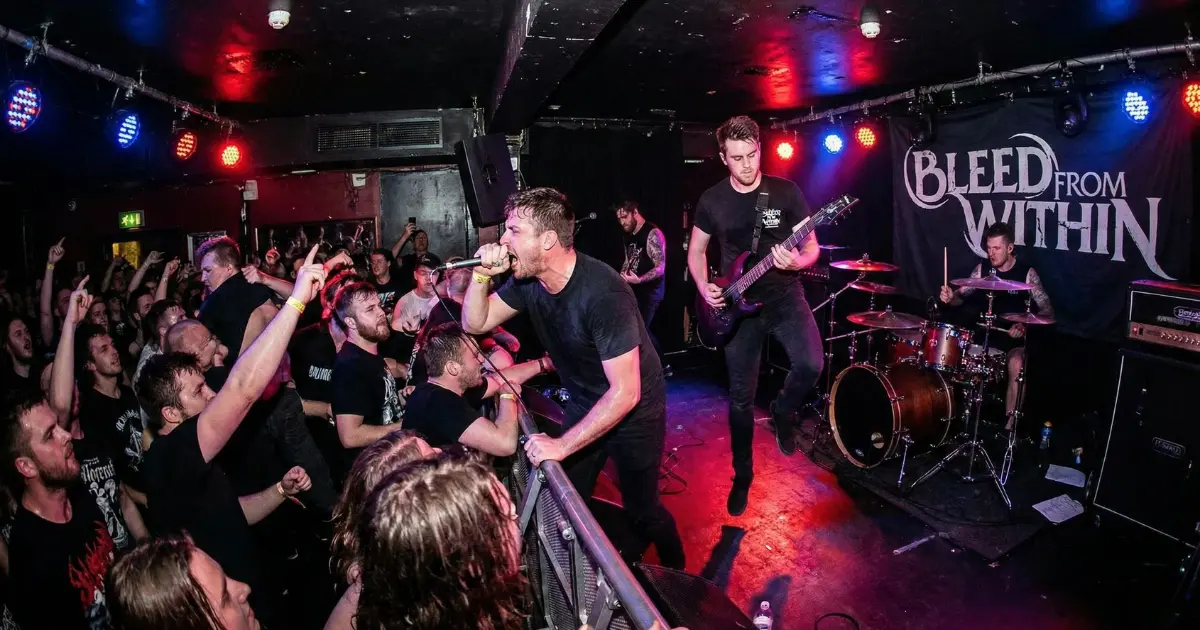
The ***** Pit: Metalcore inherited the “***** dance” style, which involves individualistic moves like “two-stepping” (rhythmic footwork), “windmilling” (swinging arms), and “crowd killing” (attacking the edge of the pit). This clash of etiquettes often leads to violence at mixed-bill shows, serving as a physical manifestation of the genre’s identity crisis. Moshing overview (Wikipedia)
10.2 Gatekeeping and Legitimacy
Since its inception, metalcore has been the target of derision from the broader heavy metal community. In the 2000s, the term “Mallcore” was used as a slur to describe the genre’s commercialization and teenage fanbase. Why metal vs. metalcore conflict? (r/Metalcore) Metal purists argued that the inclusion of breakdowns and focus on fashion invalidated the music’s “metal” status. However, historical data suggests that metalcore has served as the primary recruitment tool for heavy metal, bringing millions of young fans into the ecosystem who eventually explore deeper genres. Metalcore as gateway genre (Wikipedia)
10.3 Lyrical Evolution: The Shift Inward
The lyrical themes of metalcore map the anxieties of each generation.
The 90s (External): Focused on society, politics, and the environment. “The World is Broken.” Political/activist themes context (Earth Crisis)
The 00s (Interpersonal): Focused on heartbreak, relationships, and faith. “My Heart is Broken.” Second-wave themes (BrooklynVegan)
The 10s/20s (Internal): Focused on mental health, depression, and suicide. “My Mind is Broken.” This shift, pioneered by bands like The Amity Affliction and Beartooth, reflects the growing mental health crisis among youth. Modern audience shift framing (Seat Unique)
11. Conclusion: The Unkillable Genre
Metalcore’s history is a testament to the power of adaptation. It began as a niche fusion of two dying scenes in the 1980s and evolved into a global cultural force. It survived the collapse of the music industry, the mockery of elitists, and the saturation of its own trends.
Today, metalcore is less a specific sound and more of a shared lineage. A band like Bad Omens (playing arenas with pop songs) and a band like Knocked Loose (playing festivals with dissonant noise) sound nothing alike, yet they share the same DNA: the breakdown, the scream, and the desire to turn negative emotion into kinetic energy. As it enters its fourth decade, metalcore remains the vibrant, beating heart of modern heavy music.
12. Essential Listening Chronology
To fully understand the evolution described in this report, the following albums serve as the definitive auditory timeline:
Crossover Era: D.R.I. – Crossover (1987)
Metallic *****: Earth Crisis – Destroy the Machines (1995)
Mathcore: Converge – Jane Doe (2001)
Melodic Breakthrough: Killswitch Engage – Alive or Just Breathing (2002)
Commercial Peak: As I Lay Dying – Shadows Are Security (2005)
The Scene Era: Attack Attack! – Someday Came Suddenly (2008)
Progressive Era: Architects – All Our Gods Have Abandoned Us (2016)
Modern Era: Bring Me The Horizon – Post Human: Survival Horror (2020)